
Prajnaparamita isn’t a goddess in the usual Pagan sense. She is wisdom itself — prajna — which has gone beyond — paramita. In Mahayana Buddhism she is the ‘Perfection of Wisdom’, and also the personification of that wisdom: a luminous, maternal presence often called the ‘Mother of all Buddhas’, because it is insight into reality (as it truly is) that gives rise to awakening.
If you’re drawn to her, devotion can be both simple and profound: not a plea for favours, but a willingness to be re-educated by reality. This guide is for those drawn to contemplative practice, whether from Buddhist, Pagan, or secular backgrounds, who want to approach Prajnaparamita with sincerity. It offers mythic and doctrinal context, correspondences, altar inspiration, devotional rhythms, acts of service, and a full moon ritual all designed to help you build a grounded, respectful relationship with Prajnaparamita in contemporary life.
I first encountered Prajnaparamita as a student and later as a priestess of the Mt Shasta Goddess Temple, where I trained under Yeshe Meryemana Matthews, a Western Pagan priestess with a Tibetan Vajrayana Buddhism lineage. The temple’s tradition explicitly integrates Buddhist wisdom practices within a goddess-centred devotional framework. That shaped my approach: reverent toward the Buddhist tradition, honest about what is modern devotional innovation, and committed to practice over aesthetics.
A note on spelling: I’ve used simplified transliterations (Prajnaparamita rather than Prajñāpāramitā) throughout for accessibility. The pronunciation and meaning remain the same.
On meditation
Many of the practices in this guide involve sitting quietly, whether with the Heart Sutra, during the seven-day cycle, or in daily practice. If meditation is new to you, here’s a simple foundation.
Find a comfortable seat where your spine can be upright without strain. Rest your hands in your lap or on your thighs. Close your eyes or soften your gaze downward. Bring your attention to your breath, not controlling it, just noticing the natural rhythm of inhale and exhale.
Your mind will wander. This is completely normal and not a failure. When you notice you’ve drifted into thought, gently return your attention to your breath, again and again. This returning is the practice.
Start with five minutes if that feels manageable. Consistency matters more than duration. Some days will feel calm; others will feel restless or chaotic. Both are fine. You’re not trying to achieve a particular state; you’re practising being present with what is.
There are many meditation traditions and techniques. What’s offered here is simply a starting point for the devotional work ahead.
Traditional and adaptations
Because Prajnaparamita belongs to a living Buddhist tradition, it matters to be clear about what we’re doing.
Traditional approaches often include:
- studying the Prajnaparamita texts (especially the Heart Sutra)
- meditation and insight practice
- recitation/chanting as contemplative practice
- simple offerings (water, light, incense) made reverently
- ethical living and compassion-in-action
What’s modern (and mine) in this guide:
- a seven-day devotional structure (for rhythm and momentum)
- a full moon devotion ritual format (kept contemplative rather than spellwork)
- correspondence lists (used symbolically, not as requirements)
If you are Buddhist, practising under a teacher, or part of a lineage, keep what aligns with your practice and discard the rest. If you are not Buddhist, approach with humility: don’t claim Buddhist titles, don’t treat sutras as décor, and don’t turn emptiness into a ‘manifestation hack’.
On criticism and context
This guide will not satisfy Buddhist purists, and I don’t expect it to. I’m presenting practices as I learned them within the Mt Shasta Goddess Temple tradition, a lineage that consciously bridges Pagan goddess devotion and Buddhist wisdom teachings. This isn’t orthodox Buddhism, and it doesn’t claim to be. It’s a devotional framework for people who work eclectically but want to approach Prajnaparamita with integrity.
If you’re Buddhist and this feels wrong to you, trust that. If you’re not Buddhist but drawn to this wisdom, proceed with humility and keep learning. The point isn’t to gatekeep or to grab; it’s to honour a specific tradition while acknowledging its liminal position.
Who is Prajnaparamita?
Prajnaparamita is the heart of a family of Buddhist teachings known as the Prajnaparamita Sutras. These teachings point to emptiness (shunyata), not as nihilism, but as the insight that all things arise through causes and conditions, without fixed, independent essence.
Seen clearly, this doesn’t make life meaningless. It makes life more intimate, more relational, and more ethically charged: everything affects everything. When we stop clinging to the illusion of solidity — to me and mine, to certainty, to control — compassion becomes more natural. Wisdom and compassion are two expressions of the same seeing.
A phrase you’ll often encounter is: ‘Form is emptiness; emptiness is form.’ In practice, it’s a lifelong invitation to meet the world as moving, contingent, alive, and to stop demanding that it hold still for us.
Pronunciation and names
Prajnaparamita is commonly pronounced prah-JNAH-pah-rah-MEE-tah. You may also see: The Perfection of Wisdom and The Mother of all Buddhas.
Say her name slowly. Let it be an invocation of clarity rather than a request.
The Heart Sutra as devotion: how to work with it
The Heart Sutra is the most widely known Prajnaparamita text. It’s a short, potent teaching on emptiness that distills the essence of the longer Perfection of Wisdom scriptures. It’s chanted, studied, and contemplated across Buddhist traditions.
You don’t need to understand the Heart Sutra intellectually before you begin. Treat it like a contemplative practice, a doorway, and let it work on you over time. I’ve been reciting it for a few years, daily in January, the month I dedicate to Prajnaparamita. Sometimes it feels like nonsense. Sometimes it feels like I’m having an argument with reality. Sometimes it feels like a revelation. Sometimes it’s a deep knowing and I can only nod my head.
There are many translations available of the Heart Sutra. Choose one that feels clear and alive to you. What matters is that the words land in your practice.
A simple method:
- Read it aloud once, slowly, without rushing.
- Sit in silence for 2–5 minutes afterwards. No analysis. Just breath and presence.
- Choose one phrase to carry through the day (for example, ‘form is emptiness’).
- Journal one sentence: ‘If this is true, then today I will…’
- Repeat weekly, or daily for two weeks, and notice what shifts in your reactivity and grasping.
Correspondences
If you work with correspondences, here’s what resonates with Prajnaparamita’s energies. Some of these are rooted in traditional Buddhist symbolism; others are personal or come from the Mt Shasta Goddess Temple (MSGT) tradition. Use these as anchors for attention. If something here doesn’t resonate, keep your practice simple.
Themes
- Wisdom
- Compassion
- Emptiness
- The illusory nature of things (the shimmering, rippling landscape of appearance)
- Non-arising
- Meditation (and meditative insight)
Sacred animal
- Deer: peace, harmony, longevity, gentleness, serenity (traditional Buddhist association; Deer Park is where the Buddha gave his first teaching after enlightenment, making deer a symbol of the dharma itself; adapted here for Prajnaparamita)
Colours
- White: purity, emptiness, clarity of enlightened thought (traditional)
- Gold: radiance of awakening; precious wisdom (traditional)
- Indigo: depth; meditative insight; inner vastness (personal)
Crystals (optional)
- Clear quartz: clarity of thought; amplification of intention (personal, MSGT)
- Amethyst: meditation; spiritual insight (personal)
- Selenite: purification; mental clarity; cleansing a space (personal)
Incense and oils
- Lotus (oil or scent): awakening; the unfolding of wisdom (traditional Buddhist symbol)
Plants, flowers, herbs
- Lotus: spiritual rebirth and purity; rising from darkness into light (traditional Buddhist symbol)
- Jasmine: calm focus; gentle devotion (personal)
Offerings
Offerings are about generosity, attention, reverence, and letting go.
Keep it simple:
- Water (clean, cool, refreshed regularly)
- Light (a candle or small lamp)
- Incense (if you use it)
- Fruit, or a small bowl of rice
- A single flower
Altar inspiration
Prajnaparamita devotion thrives in simplicity.
Core setup
- white cloth
- one white or gold candle
- bowl of fresh water
- lotus symbol (flower, image, or drawing)
- a clarity stone such as clear quartz or selenite (optionally)
On statues and images
I like using statues and images on my altar, but Prajnaparamita statues are difficult to find and often expensive. When I visited Mt Shasta for the temple’s priestess retreat a few years ago, I found a White Tara statue I fell in love with, and I use that. White Tara shares Prajnaparamita’s qualities of wisdom, compassion, and protective presence, and in Vajrayana understanding, all Buddha-forms express the same enlightened nature. They are distinct figures — White Tara has her own iconography and practice — but the resonance is there.
A statue of Quan Yin could work for similar reasons: compassionate, maternal energy; wisdom and protection. These are much easier to find and often more affordable.
I also have a framed illustration of Prajnaparamita on my altar, created by Devanna of The Wild Empress. Devanna is one of the temple’s priestesses and teachers. Her depiction shows Prajnaparamita seated on a lotus throne above Mt Shasta, holding the Heart Sutra and a mala, with the sacred syllable AH in the sky above her. It’s situated in the temple’s Siskiyou County landscape, grounded by wild ginger flowers native to the region.
If using White Tara or Quan Yin feels inappropriate to you, a simple lotus symbol, a printed image of the Heart Sutra text, or the written Sanskrit syllable for prajna may be more suitable. What matters is that the image helps anchor your devotion, not that it’s iconographically perfect.
Seven-day devotional practice
If gentle structure helps you start (or deepen), try this cycle. Repeat as often as you like.
Day 1: Begin with not-knowing. Light a candle. Sit for a few minutes and reflect on where you demand certainty.
Day 2: The practice of seeing. Read the Heart Sutra aloud once. Sit in silence and reflect. What is solid that might actually be moving?
Day 3: Compassion without rescue. Do one small compassionate act.
Day 4: Thoughts as weather. Spend 10 minutes watching thoughts rise and pass. Which story keeps returning?
Day 5: The single offering. Offer water (or a single grain of rice) with full attention. What changes when you make something so small sacred?
Day 6: Study as devotion. Read a page or two of a trusted teaching or commentary. What is the difference between information and insight in you?
Day 7: Integration. Choose one vow small enough to keep this week (patience, honesty, listening, restraint).
Daily wisdom practice
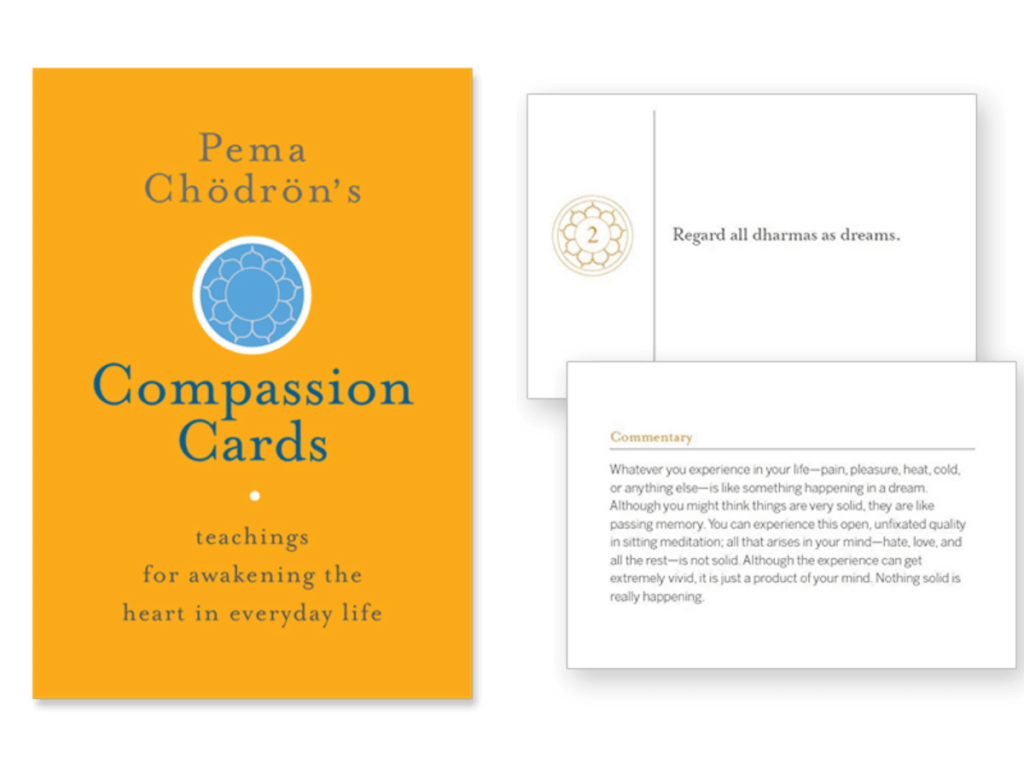
I’m a tarot reader, and I love drawing a card each morning as a message from the divine or to guide my day. But in January, I use Pema Chödrön’s Compassion Cards every day instead. I also return to them throughout the year when I need to recalibrate myself, to get back to something simpler and truer.
The cards are based on lojong, a classic Tibetan Buddhist practice for training the mind and heart. It’s a set of 59 teachings or slogans designed to transform all circumstances into opportunities for compassion, fearlessness, and awakening. Each card has one of the lojong slogans on the front and Pema’s practical commentary on the reverse, making ancient teachings immediately workable in contemporary life. They’re not prescriptive or predictive; they’re contemplative. They ask you to sit with a teaching rather than seek an answer.
They’re also deceptively simple. Some mornings a card will land gently. Other mornings it will call out exactly the behaviour or pattern I’ve been avoiding, and I’ll sit there thinking, “Well, Pema, ouch, that was direct.” They have a way of being kind and uncompromising at once.
Signs you’re on track (and signs to recalibrate)
Prajnaparamita practice isn’t about dramatic spiritual experiences or feeling perpetually blissed out. It’s quieter than that, and more practical. You’ll know the work is landing when your responses to life begin to shift. It won’t happen all at once, but steadily, almost imperceptibly at first.
On track might look like:
- less reactivity, even when you’re tired
- more patience with complexity and ambiguity
- clearer boundaries without harshness
- softer self-talk; fewer certainty-addictions
- compassion that becomes ordinary, practical, consistent
Recalibrate if you notice:
- using ’emptiness’ to dismiss feelings or needs
- spiritual bypassing (using ‘it’s all illusion’ to avoid dealing with real harm or difficult emotions)
- coldness framed as wisdom
- chasing special experiences or signs to feel legitimate
- treating devotion as a productivity tool rather than a practice of integrity
Acts of service
Prajnaparamita devotion isn’t separate from compassion; wisdom and compassion arise together. Service here means practising presence, reducing suffering where you can, and meeting people as they are:
- Support a local Buddhist temple, dharma centre, or meditation community especially those offering free teachings or serving underresourced populations
- Donate to organisations supporting girls’ education and literacy, particularly in regions where access is restricted
- Volunteer at a community meal service, food bank, or shelter
- Offer childcare for a parent who needs time for rest, medical appointments, or their own practice
- Sit with someone who is grieving, sick, or lonely without trying to solve anything
- Help an older neighbour with shopping, errands, or simply checking in regularly
- Practise one ‘wisdom ethic’ in conversation: listening without rehearsing your reply
- Choose one day a week to speak only when your words improve on silence
- Offer your seat, your time, or your attention without mentioning it
Let service be simple. Let it be consistent.
Full moon ritual for Prajnaparamita
This ritual honours Prajnaparamita through active practice—clearing obstacles to wisdom and inviting clarity into your life and the lives of others. If you use a Wiccan framework, you can adapt this ritual to fit it. For example, you might consecrate the water at the start of your ritual as usual.
Preparation
Find a quiet space where you won’t be interrupted for 30-45 minutes. If possible, sit where you can see the moon.
Set up
- White cloth
- White or gold candle
- Bowl of clean water (fresh or moon water)
- A representation of Prajnaparamita
- Clear quartz or your chosen clarity stone (optional)
Invocation
Light the candle. Take three slow, deliberate breaths, feeling yourself settle into presence. Speak:
“Prajnaparamita, Perfection of Wisdom, Mother of all Buddhas, Mother of clear seeing, be welcomed here. You who are wisdom itself, carried to its farthest shore, I call upon your presence. May my mind become honest. May my heart become brave. May wisdom and compassion arise together, here and in all beings. I ask for your aid in the work ahead.”
Offering
Offer water, fruit, or a small bowl of rice. Say:
“I offer this gift in gratitude and in partnership. As you illuminate reality, help me see clearly. As you cut through delusion, help me release what clouds true seeing, for the benefit of all beings.”
The work: clearing and illumination
- Name the obstacle: Sit quietly and bring to mind one specific thing that’s blocking clear seeing in your life right now—a story you’re telling yourself, a pattern of reactivity, a way you’re clinging to certainty, a fear that keeps you small. Be specific. Hold it clearly in your awareness.
- Consecrate the water: Hold your hands over the bowl of water. Visualise moonlight (or the light of wisdom) pouring down through your crown, through your heart, through your hands, into the water. Feel it become charged with clarity and compassion. Say: “By Prajnaparamita’s wisdom, this water becomes a tool of liberation. May it wash away delusion and reveal what is true.”
- The release: Speak your obstacle aloud to the water, naming it clearly three times. Be direct and honest—no euphemisms, no softening. Then say: “I release this [name it] into wisdom’s care. Form is emptiness; emptiness is form. What I grasped dissolves. What seemed solid reveals its true nature. May clarity arise where delusion once lived.”
- The clearing: Dip your fingers in the consecrated water and anoint yourself—forehead (clear seeing), throat (clear speaking), heart (clear feeling), solar plexus (clear knowing), hands (clear action). With each anointing, say: “May wisdom arise here.”
Sit in the clarity: Rest in silence for 5-10 minutes. Don’t try to fill the space with more practice. Just be present with what’s been cleared. Notice what arises or what doesn’t.
Closing
Touch your hands to your heart. Speak:
“Prajnaparamita, Mother of Wisdom, I thank you for your presence and your aid. The work of seeing clearly continues. May this clearing serve not only me, but all beings who struggle with delusion and grasping. As the moon illuminates the night, may wisdom illuminate all hearts, for the benefit of all beings.”
Pour the consecrated water onto soil outside, or into a potted plant, returning it to earth. Extinguish the candle carefully.
After the ritual
Dispose of food offerings respectfully. Notice in the days following if the pattern you released has loosened its grip, even slightly. This is not one-and-done magic; it’s cultivation.
Final thoughts
Prajnaparamita meets us where we are—in confusion and clarity, in grasping and letting go, in the daily work of learning to see more honestly. She doesn’t demand perfection or dramatic transformation. She invites us into the patient, ongoing practice of waking up to reality as it actually is.
This work is both simple and profound. Light a candle. Speak her name. Sit with the Heart Sutra. Notice where you’re clinging and practise releasing just a little. Offer what you can—water, attention, a moment of genuine presence. Let the practice unfold at its own pace.
Wisdom isn’t something we achieve and tick off a list. It’s something we cultivate, return to, and deepen over time. Some days it will feel natural and flowing. Other days it will feel like walking through mud.
Begin gently. Practise consistently. Trust that small, steady efforts compound into genuine transformation. And remember that wisdom and compassion aren’t separate; they arise together, clarifying how we see and deepening how we care.
May your practice be steady. May your heart stay open. May wisdom and compassion guide you on your journey.