

When I visited Aphrodisias in 2023, I didn’t yet have words for what was happening. I knew I stood in a place that mattered, one of the great sanctuaries of Aphrodite in the ancient world. What I did not yet know was how deeply it would change my relationship with the goddess—how curiosity and awe would become more personal, unsettled, and transformative.
I came as part of a small group. My teacher and friend, Yeshe Matthews, from the Mt Shasta Goddess Temple, leads pilgrimages, and my husband and I timed our own trip through Türkiye so that we could join her group for a week. Travelling sacred land with someone who appreciates its significance is wholly different from the average tourist experience. I felt this difference immediately.
Aphrodisias sits inland, in what is now Türkiye, near modern-day Geyre. At first glance, it seems like an unlikely home for Aphrodite, a goddess so often associated with the sea. But the site tells a deeper story. Long before it bore her name, this was already sacred ground. An older Anatolian goddess was worshipped here, likely connected to fertility, protection, and the rhythms of the land. When Greek culture spread through the region, this local deity was identified with Aphrodite.
By the time the city flourished under Roman rule, its identity was firmly established. The Romans recognised Aphrodite as Venus, but they did not rename the city. In the Greek-speaking eastern provinces of the empire, Aphrodite remained Aphrodite. Aphrodisias remained Aphrodisias. That continuity allowed the city to be both deeply local and fully integrated into the Roman world, a place where devotion, politics, and identity overlapped.
On the first day, we visited the museum and explored the archaeological site. My husband and I went in one direction, while Yeshe and our other two friends explored in another. Later, we gathered outside the café across from the museum, had ice cream and cold drinks, and looked through the things we’d bought. As we sat there in the afternoon warmth, a squirrel ran across the roof of the café and dropped its walnut. It rolled down the tiles and fell onto the ground. The squirrel kept going. My husband stood, picked up the walnut, and threw it back up onto the roof. The squirrel returned immediately, took the walnut, and paused. It sat up on its haunches and raised its little paws, the way a squirrel does when it holds something, but to all of us it looked like a gesture of gratitude. There was a collective ‘aww’, and then the squirrel ran off. We felt it: the lightness of a place that is still, somehow, under the care of something gracious.
The following day, we returned—this time without my husband, who stayed at the hotel to watch the AFL Grand Final. We held a devotional ritual in the Temple of Aphrodite.
My husband and I took about 200 photos of Aphrodisias. Here are some of my favourites.
The Aphrodisias Museum
The Aphrodisias Museum, opened in 1979, displays the remarkable finds excavated from the ancient city. Famous for its sculpture school, Aphrodisias produced exceptional marble works between the 1st century BCE and 5th century CE, using stone from nearby quarries. The museum features statues of philosophers, emperors, gods, and heroes, alongside sarcophagi, reliefs, prehistoric artefacts, coins, and the celebrated cult statue of Aphrodite. It is one of Anatolia’s finest archaeological museums and a powerful introduction to the city’s artistry and history.
We tend to encounter ancient sculpture in its finished, idealised form. One of the pleasures of this museum is seeing pieces in various stages of completion — works abandoned mid-carving, or left unfinished. It made the sculptors feel present in a way that polished masterpieces sometimes don’t.


The Sevgi Gönül Hall is most impressive. It houses the magnificent marble reliefs of the Sebasteion of Aphrodisias, a first-century CE temple complex dedicated to Aphrodite and the Julio-Claudian emperors. These panels once lined a grand processional avenue and depict emperors such as Augustus, Tiberius, Claudius, and Nero alongside gods, heroes, myths, and the many peoples of the Roman world. Displayed together, they reveal how art was used to express power, piety, and identity in the Greek East under Roman rule.


One of my favourite reliefs here was that of Achilles and Penthesilea. This stunning relief shows Achilles supporting the collapsing Amazon queen Penthesilea, whom he has mortally wounded in battle. Her double-headed axe slips from her hand. Penthesilea had come to aid Troy against the invading Greeks, and ancient myth says that as she lay dying, Achilles looked upon her face and was struck by love, admiration, and remorse.

This relief of the local goddess Aphrodite was defaced in the Christian period. Such acts reflected the belief that pagan images could house dangerous spiritual powers, which were thought to be neutralised through mutilation and by carving a cross onto the side of the altar.

This fascinating relief depicts the cult statue of the local Aphrodite of Aphrodisias standing upon a round base, while a dynamic, draped figure of the classical Greek Aphrodite approaches, poised to crown her own image. Between them rises a slender incense burner. It does not show one form of the goddess replacing the other. It shows recognition, continuity, and a meeting of forms. It’s the Aphrodite I thought I knew, acknowledging the one I did not. This beautiful scene of pagan devotion was deliberately defaced on Christian initiative, probably in the fifth century CE.
The goddess Aphrodite


The Aphrodite of Aphrodisias is the city’s distinctive image of the goddess, blending an older Anatolian mother deity with the Greek Aphrodite. Standing frontally in rich ceremonial dress, she is adorned with symbolic panels showing the Graces, Sun and Moon, sea imagery, and Erotes. This Aphrodite was both an ancient local protectress and a classical goddess of beauty, love, and cosmic influence.
She does not resemble the image most of us carry in mind. She is not the soft, luminous figure emerging from the sea, nor the idealised nude of classical sculpture. She stands upright, columnar, richly adorned, her body covered in bands of symbolic imagery.
Years earlier, I struggled with Aphrodite’s image—often shaped by male artists and desire. She was presented as beautiful, yes, but also superficial, petty, a projection rather than a presence. I wasn’t interested in a goddess existing for the male gaze.
Standing before this statue, I encountered something different—something older, sovereign. Her hands are missing, but her gesture is unmistakable. As I stood there for a long time, I felt a quiet internal shift. The distance I had kept began to soften. I left the temple not with answers, but with a sense that something within me had loosened, inviting connection where once there had been hesitation.
This Aphrodite helped me understand the goddess—and love—as a cosmic force that draws, compels, binds, and unsettles. And she softened me, over time, towards the classical image: the nude figure so often reduced to beauty and desirability and aesthetic ideal. My relationship with Aphrodite, and with love itself, became more nuanced, expansive, and open.
We often take Aphrodite’s nudity for granted, assuming she was always depicted that way. Yet in early Greek art, Aphrodite was usually clothed. While the nude male body could be admired as heroic, athletic, and ideal, public female nudity was treated far more cautiously. When Praxiteles created the Aphrodite of Knidos in the 4th century BCE, centuries after the earliest nude male statues, it caused a sensation and became one of the most famous and widely copied images of Aphrodite in the ancient world.
Ancient art is often discussed through the lens of male viewers, yet women also visited sanctuaries, festivals, and civic spaces. They too encountered Aphrodite. In this form, the nude goddess helped make culturally visible something striking: the female body as worthy of monumental artistic celebration, not merely concealed, regulated, or treated as secondary. Alongside ideals of modesty, domestic virtue, and chastity, Aphrodite’s image also suggested beauty, desire, presence, and feminine power.
Somehow, the ancient Anatolian Aphrodite and the classic Greek Aphrodite illuminated each other.

Aphrodisias, the metropolis

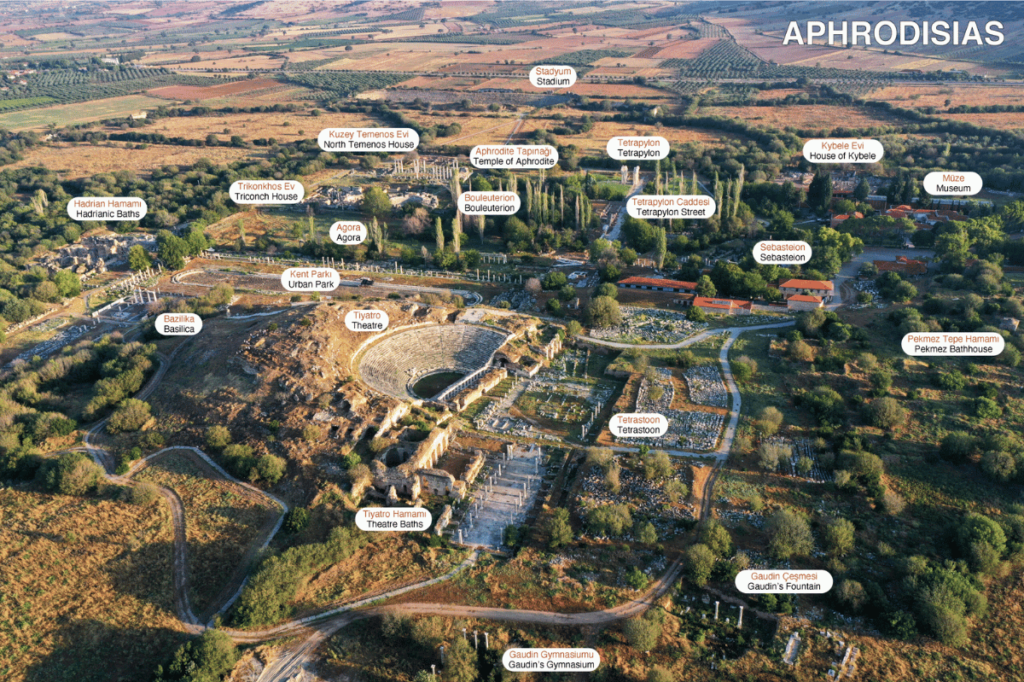
The Tetrapylon of Aphrodisias was the grand ceremonial gateway to the sanctuary of Aphrodite. Built in the 2nd century CE, its sixteen columns and lavish carvings marked the passage from the public street into sacred space. In the Christian era, an image of Aphrodite in the pediment was deliberately erased and replaced with a carved cross. Beautifully reconstructed from original stones, it remains one of Aphrodisias’s most striking monuments, and the most beautiful monumental gateway I have seen. I felt the threshold as I crossed it. Something changed in the quality of the air, or perhaps in myself.

The city grew around the Temple of Aphrodite, which stood at its centre both physically and symbolically. What began as a modest sanctuary was expanded into a monumental complex, reflecting the goddess’s importance to the city’s life. In the fifth century, the ancient temple was transformed into a church, the Cathedral of St Michael. Despite fire, war, and earthquakes, many columns, walls, and the apse still stand, revealing layers of pagan and Christian history in one remarkable monument.

The Stadium of Aphrodisias is one of the best-preserved ancient Greek stadia and among the largest, seating around 30,000 people. Built in the first century CE, it hosted athletic games, festivals, gladiatorial combats, and wild-beast shows. Seat inscriptions still reveal the names and communities that gathered here.

The Hadrianic Baths were the city’s largest public baths, built in the early second century CE and dedicated to Emperor Hadrian. More than a place to wash, they were a social and cultural centre of relaxation, conversation, and display. With marble-lined pools, heated rooms, grand colonnades, and fine statues, the baths combined engineering, luxury, and art on an impressive scale.

The Urban Park at Aphrodisias was the city’s second public square, set beside the Agora. Framed by grand colonnades, the Theatre, Basilica, and monumental gateways, it later featured a vast ornamental pool lined with palm trees. In Late Antiquity, it was known as the Place of Palms, a Roman-style urban park designed for beauty, leisure, and public life.

The Theatre of Aphrodisias was both an entertainment venue and a civic meeting place where the people gathered in assembly. First built in the Hellenistic era and later expanded, it seated around 7,000 spectators. Its richly decorated marble stage once displayed statues of gods, muses, and victors.

The Sebasteion of Aphrodisias was a magnificent first-century temple complex honouring Aphrodite and the Roman emperors. A grand processional avenue led to the temple, lined with multi-storey marble façades adorned with hundreds of reliefs, many of which are now housed in the Sevgi Gönül Hall, as described above.
The ritual
I find it difficult to describe what happened on that second day in the Temple of Aphrodite. The outward actions are simple enough: we brought offerings, we spoke words, we stood in that ancient space and offered what we had to give. What is harder to describe is the quality of presence that gathered around those simple acts.
What I mostly felt was peace, a settling. I had come to this place carrying years of complicated feelings about Aphrodite, and standing in what had once been her temple — stone that had held her name and her worship for centuries before the church came — I felt something in that complication start to quietly resolve. I felt more connected to her than I ever had. She had been here so long, in so many forms, and something of her was still here.
The real effects, though, came later, or perhaps I carried them home with me.
In the days that followed, I noticed sparrows. Half a dozen of them, most mornings, gathered near me. This might seem like nothing, but sparrows are one of Aphrodite’s sacred birds. In antiquity, they were said to draw her chariot. Sappho invokes them in her famous prayer. I had not looked for them. They were simply there, morning after morning, and I understood them as I understand all such things: not as proof of anything, but as the goddess continuing the conversation we had begun.
I also brought home a replica of the cult statue. She sits on a shrine in my home now. The columnar Aphrodite of Aphrodisias, adorned with her symbolic panels, standing with her missing hands and her unmistakable gesture. The Aphrodite I did not expect to find.
Aphrodisias is now recognised as a UNESCO World Heritage Site, valued for the preservation of its ruins and the insight it offers into the ancient world. But for me, it is more than that. It is a place where histories overlap — Anatolian, Greek, Roman, Christian — where a goddess takes on different forms without losing herself, where stone holds memory and meaning. And it is the place where I finally met Aphrodite properly. Where she showed me what she actually was, and I stopped looking away.
Love this follow-on from your 2022 reflection on Aphrodite.
Thank you. My visit to this city was a real turning point in my relationship with Aphrodite.