
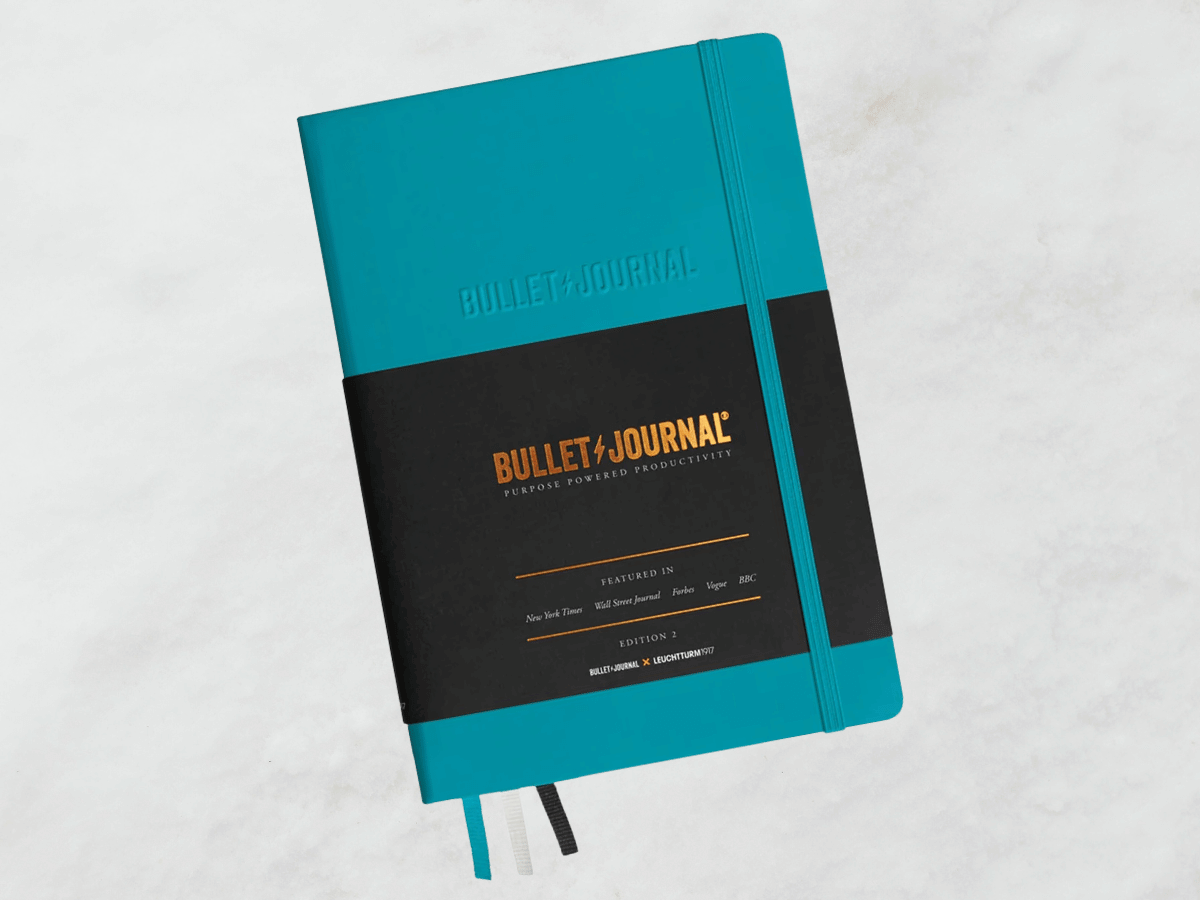
It’s become a January tradition I genuinely look forward to: setting up my new Bullet Journal. My 2025 journal served me well, but there’s always something exciting about starting fresh with lessons learnt. Here’s what my 2026 minimalist setup looks like.
But first, what is a Bullet Journal?
The Bullet Journal is an analogue organisation system created by digital product designer Ryder Carroll. It’s part planner, part diary, part to-do list—all customisable to suit how you actually work.
The basics are simple: numbered pages, an index to find things, logs for tracking tasks and events, and a system for migrating incomplete tasks forward. That’s it. The beauty is in the flexibility.
Of course, if you search for Bullet Journals online, you’ll find elaborate spreads with artistic flourishes. Whilst beautiful, I can’t keep up with that aesthetic. My approach is closer to Carroll’s original vision, which is now commonly referred to as minimalist or basic, because I want a system that’s sustainable, not another creative project to maintain.
A new notebook
I adopted the Bullet Journal in 2015 and have kept it simple, but it has become leaner over the years.
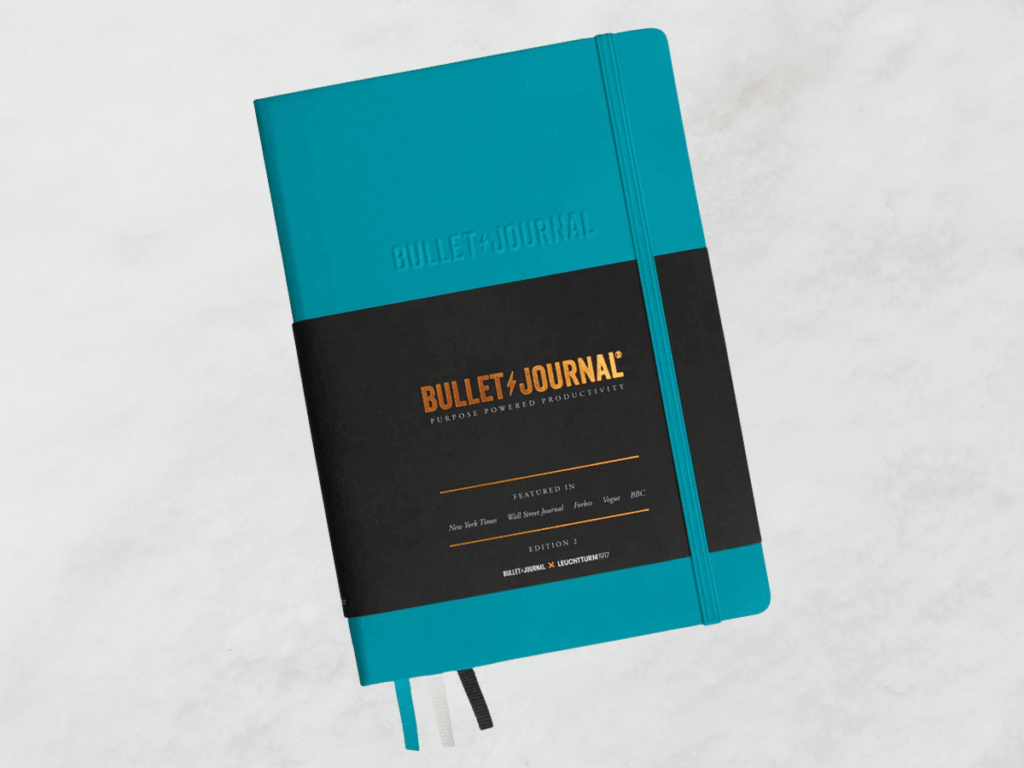
From 2015 to 2021, I used a Moleskine journal and went from the softcover grid to the hardcover dot. In 2022, I switched to the black Bullet Journal Edition 2, a collaboration between Ryder Carroll and Leuchtturm1917, and bought it again in 2023.
For 2024, I chose a Moon notebook by the German company nuuna from my stack of beautiful, unused journals. I loved the lunar graphics on the front, back, and page edges, which inspired me to buy matching washi tape. I also liked the stark white pages.
However, the nuuna is larger than the Leuchtturm1917 with a smaller 3.5mm grid (versus 5mm), making it harder to divide the grid equally on one page. This meant writing smaller or ignoring the grid, with more information fitting per page. And I missed the features of the Leuchtturm1917: a grid guide, pocket guide to Bullet Journaling, page dividers, stickers, pre-printed Index, Future Log, and three bookmarks.
Because of its bigger size and more pages, when 2025 rolled around, I still had plenty of blank pages and kept using the nunna journal. But for 2026, after much deliberation and even polling my friends, I’ve returned to the Leuchtturm1917 Bullet Journal Edition 2. Instead of my usual black, I went with turquoise, which relates to one of my 2026 goals of Yemaya devotion and water-listening.
My 2026 minimalist Bullet Journal setup
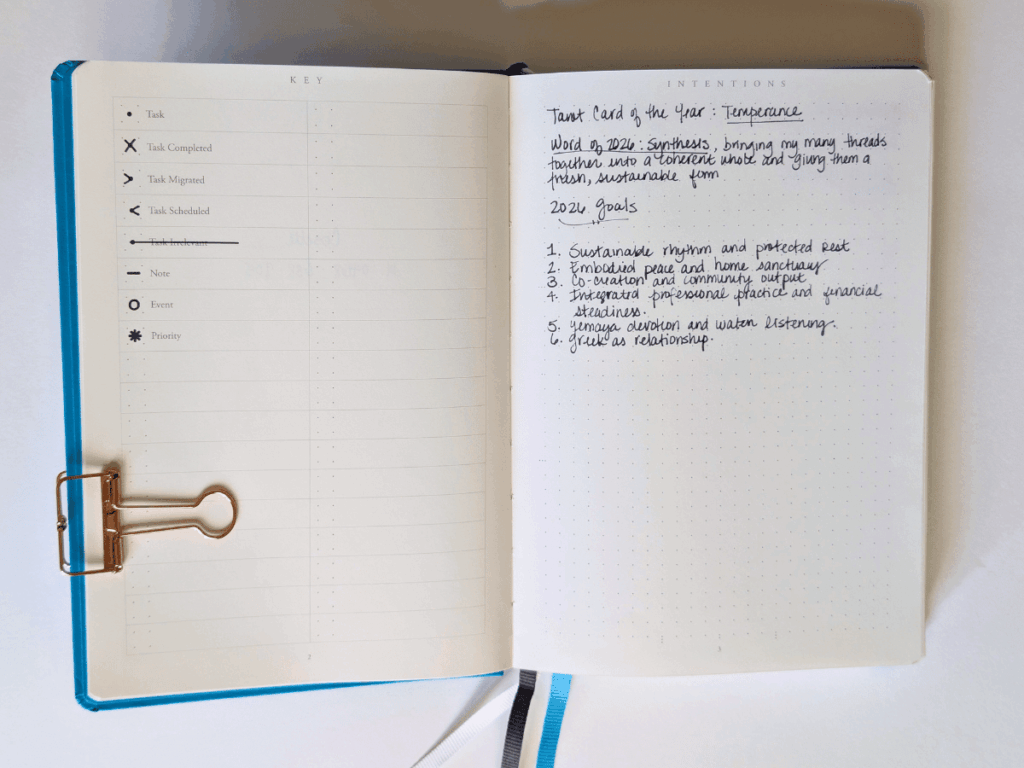
Many people begin their Bullet Journals with a key and the first spread of the Leuchtturm1917 Bullet Journal Edition 2 is the Key and Intentions. I no longer use the original key. After all these years, I’ve developed my own system based on the original. For example, I prefer checkboxes over bullet points for tasks and bullet points over dashes for notes. This is second nature to me now, so I don’t need to write it down. I tend to ignore this page.
The next page is Intentions. I’ve never found a good use for it. In the past, I’ve used it for journal blessings and quotes, but I never returned to it. I’ve added my 2026 goals, and perhaps I’ll add some quotes later.
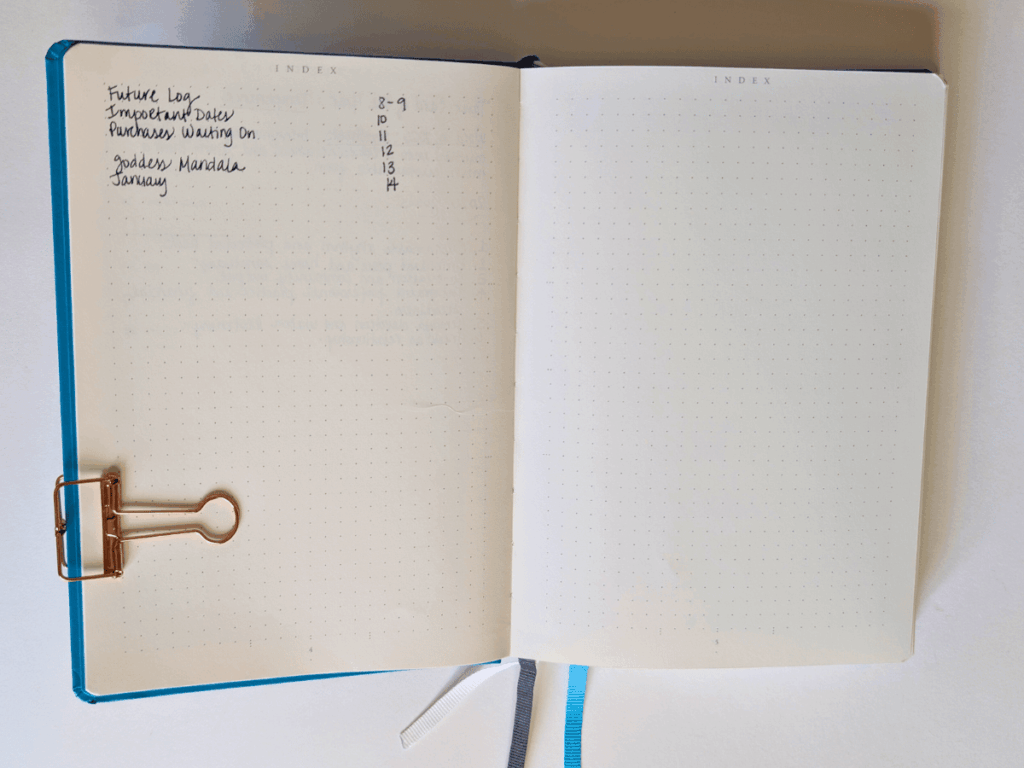
After the Key and Intentions spread, there are two spreads for the index. Previously, I didn’t need so many pages and covered the titles with correction tape or washi tape, but this year I’ve left them alone. I want to use my Bullet Journal more and in new ways, so maybe I will need the four pages.
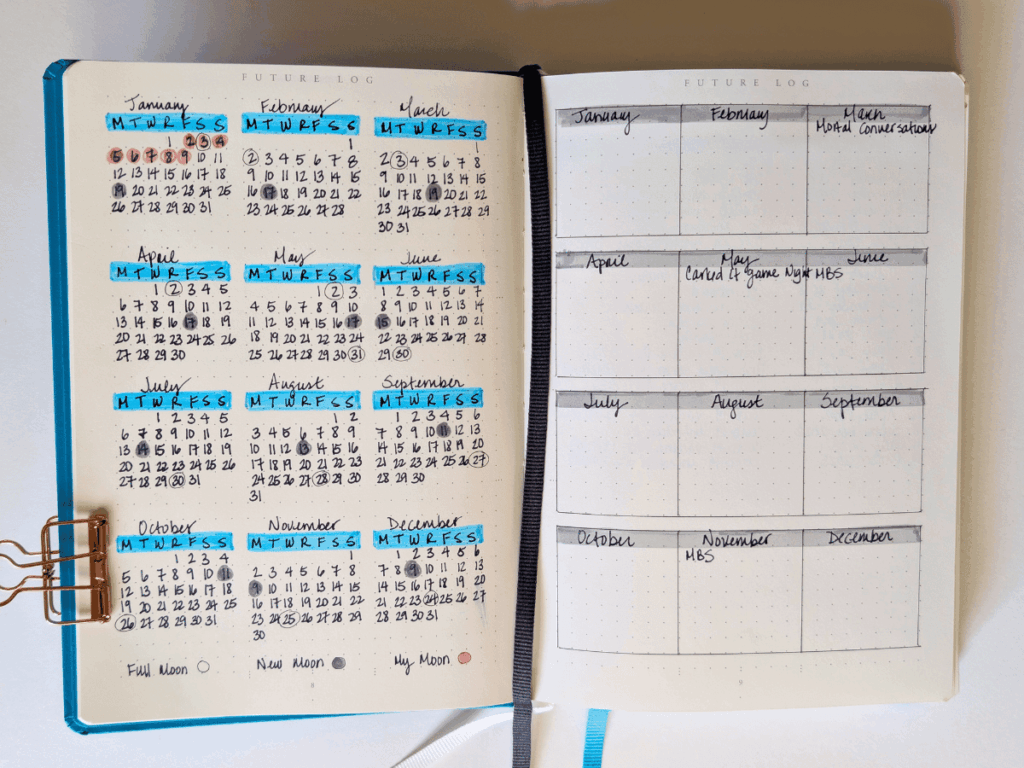
The next spread is the Future Log. I rely heavily on Google Calendar, but I like to use this spread for a year-at-a-glance.
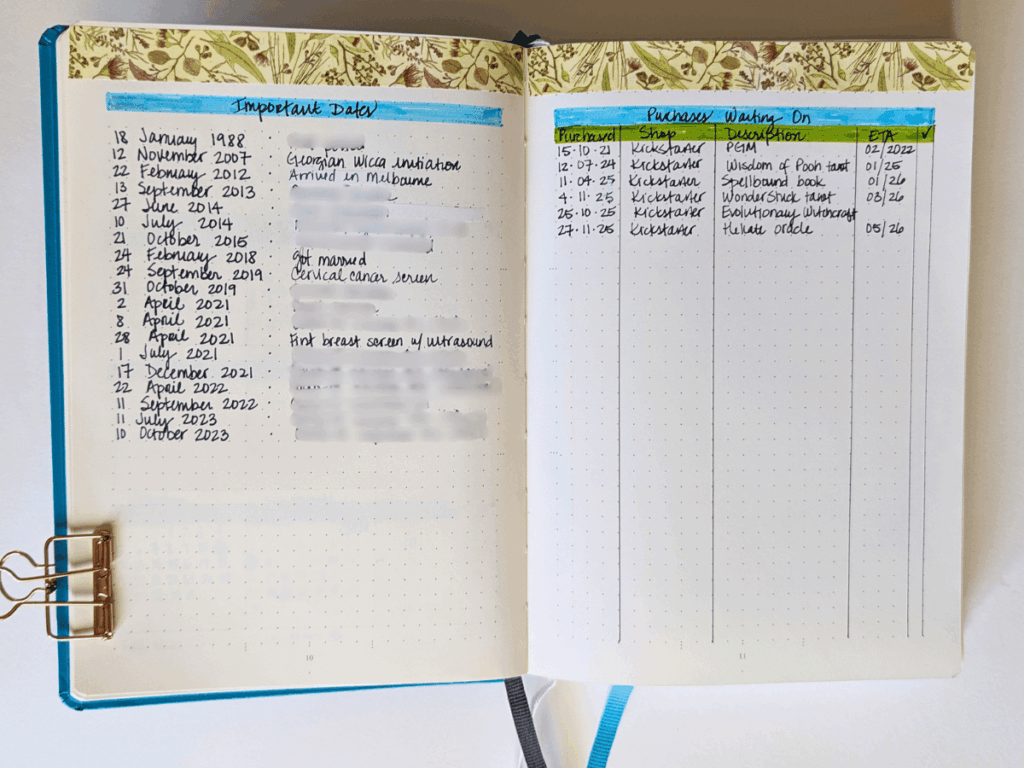
The following spread is also labelled Future Log, but I don’t need more pages for that, so I covered the titles with Australian Bush washi tape by Bridget Farmer Printmaker that I found on Washi Gang. One page is now Important Dates—essential information at a glance. It includes dates like when I came to Australia, when I got married, and when I had a cervical cancer or breast screen. My husband laughs at me for habitually forgetting our anniversary. Some of this information is captured elsewhere, such as My Health Record, Australia’s national digital health records platform, but flipping to this page is quick and easy. The other page is a short list of purchases I’m waiting for, typically online purchases that will take a long time to be fulfilled, usually Kickstarter orders.
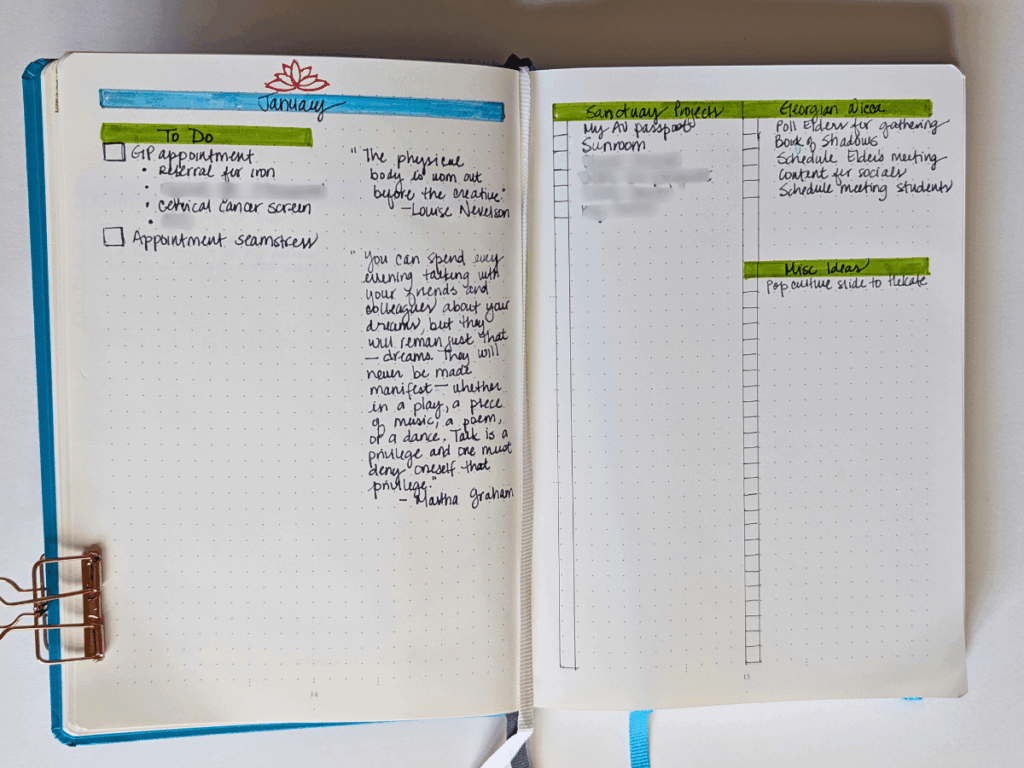
After these setup pages comes the monthly log. Whilst the Index, Future Log, Important Dates, and Purchases Waiting On carry over every year consistently, the monthly log has changed almost every year. In 2024 and 2025, I barely used the month’s list of days because of my reliance on Google Calendar, so I’ve omitted it altogether and just dived into my brain dump of to-do tasks. I also added a couple of quotes from a book I’m reading. In previous years, I’ve divided a page into various sections to reflect working areas or included spaces for ideas, achievements, and gratitudes. My current approach seems more haphazard, but it reflects my needs at the moment.
The following pages are blank. Here begin the daily notes and rapid logging. These pages are a chaotic mix of my day’s work, notes from meetings, brainstorming, planning, bits of inspiration, quotes, and so forth.
What's not in my Bullet Journal
My Bullet Journal isn’t trying to be everything. Over the years, I’ve learnt that the system works best when it complements my other tools rather than replacing them.
Book tracking lives on Goodreads. Work projects and documentation live in Notion. I have separate magical journals and my Book of Shadows—created after my initiation into Georgian Wicca—remains its own physical book, whilst other spiritual materials are stored digitally.
The weekly log appears only when I need it, and collections come and go based on what’s actually useful. My Bullet Journal has always been a temporary tool for current productivity, not an archive. Apart from a few evergreen pages like Important Dates, nothing here is meant to last beyond the year.
That said, I’m exploring new ways to use my Bullet Journal this year. I’m curious about incorporating more traditional diary entries—reflections, observations, moments worth remembering. I’m also drawn to the idea of using it as a bit of a commonplace book, the Renaissance practice of collecting quotes, passages, recipes, observations—anything worth preserving. We’ll see how it evolves.
What about pens and accessories?
Even as I’m exploring new uses for my Bullet Journal, my tools remain simple.
My workhorse pen is the inexpensive Artline 200 Fine 0.4 in black, with a Pigma Micron 005 and 01 for smaller writing. Because this journal is turquoise, I’ve chosen blue and green as accent colours, using Crayola Supertips as highlighters. I also keep the usual suspects on hand: Staedtler mechanical pencil (0.5mm) and eraser, correction tape, white gel pen, a ruler, and assorted washi tape. These mostly appear during monthly setup.
Whether I end up using this journal more like a diary or commonplace book, the aesthetic will stay the same—minimal and functional.
That’s my 2026 minimalist Bullet Journal setup. After more than a decade of using this system, I still find it valuable.
This year feels a bit different. I’m venturing into new territory with diary entries and commonplace collecting whilst maintaining the lean productivity system that’s served me well. I’m not sure exactly how it will evolve, but that’s part of the appeal.
If you’re considering starting a Bullet Journal, remember: you don’t need fancy spreads or artistic skills. You just need a notebook, a pen, and a willingness to experiment until you find what works for you.